Commercial lane
Commercial & Large Loss
Water, fire and mold losses in offices, retail and multi-unit buildings, worked by IICRC certified technicians with a 24/7 hotline.
What fails first in a commercial or multi-unit loss
A burst riser or a tripped sprinkler head on the fourth floor doesn't stay on the fourth floor. Water follows the easiest path: down pipe chases, along ceiling plenums, into wall cavities and under flooring that looks dry from the surface. By the time the first call comes in, the tenant below is reporting a stain and the unit next door has wet insulation behind finished walls.
The building isn't the only thing that fails. Tenants can't open. Inventory sits under dripping ceiling tiles. A corridor turns into a liability the moment someone slips on it, and every hour of downtime lands on the property manager and the owner at once.
This is the work behind what Strategic Source lists as Property Manager Restoration Solutions and Large Loss First Priority Industries: properties where a loss spreads across floors, units and tenants, and where the first hours decide how big the claim gets.
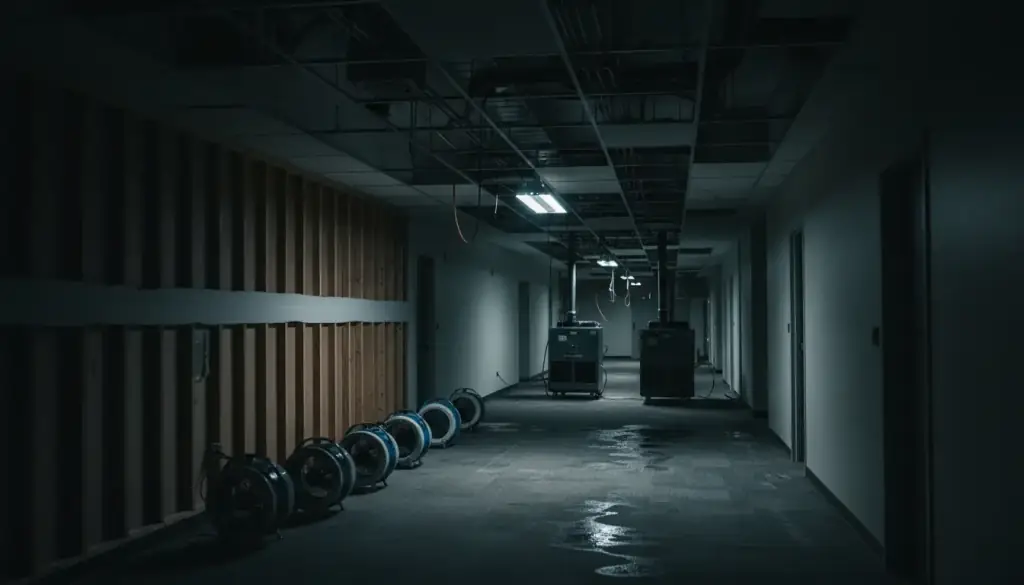
Commercial office corridor mid-drying at night, with a line of air movers, two dehumidifiers and ceiling tiles pulled out
How Strategic Source works a building: Triage, Mitigate, Restore, Back Safe & Sound
Triage starts on the hotline, which technicians staff around the clock. The first job on site is finding where the water went, not where it showed up. We map moisture through floors, walls and ceilings with meters, mark the wet boundary and shut down the source if it's still running, so the drying plan is built on readings rather than guesses.
Mitigate means getting the water out and the building under control. Extraction pulls standing water first. Then LGR dehumidifiers and air movers go in where the moisture map says they belong, and containment (poly sheeting, zippered doors, sealed returns) keeps wet work and dust away from the floors and units that are still occupied.
Restore and Back Safe & Sound follow the readings. IICRC certified restoration technicians check the moisture daily and adjust equipment as areas come in, and we don't pull a dehumidifier because a surface feels dry. Once the structure is at dry standard, the rebuild starts, and the tenants are back where they belong.
Insurance, adjusters and the paper trail a property manager needs
We work directly with your insurance, and top insurance companies trust Strategic Source to work with them and their clients. We've also partnered with a seasoned public adjuster who assesses the damage right after you call, so the claim doesn't begin with you alone on the phone with a carrier.
A commercial loss runs on documentation. We document and measure our processes: photos of what was affected before anything is removed, the moisture readings from each visit, where the equipment ran and what was taken out and why. That's the file owners, carriers and tenants all end up asking for.
Estimates are always free. If you manage a building and want to know how we'd handle a loss before you ever have one, call the hotline and ask.
Strategic Source works directly with your insurance, and technicians are available 24/7 on the emergency response hotline, (201) 204-9700.
Managing the building? Tell us what you've got.
Floors affected, units involved, whether the water is still running: that's what we need on the first call. If it isn't urgent, you can describe the damage on our contact page and we'll call you back. Smaller residential jobs follow the same four steps, starting with water damage restoration.