Water lane
Flood Damage
Basements and ground floors after groundwater, sewer backup or rising water, pumped down and dried out.
Groundwater, sewer backup and why flood water is a different job
A flooded basement usually comes from one of four places: groundwater pushing through the slab or foundation wall, a sump pump that quit or couldn't keep up, a window well that filled and spilled in, or a sewer line that backed up through the floor drain. The water that comes in carries soil, bacteria and, with a backup, sewage. That's what separates a flood from a clean supply-line break.
Restorers sort water into categories by how contaminated it is. Clean water from a broken supply line is the best case. Water that has crossed the ground outside, or come up from a sewer, is treated as contaminated, and it stays that way: anything porous it touched, like drywall, insulation, carpet and padding, usually can't be cleaned and has to come out. Left in place, it keeps releasing odor and growth long after the water is gone.
Behind the wall you can see, framing sits in water at the bottom plate, and a concrete slab holds moisture far longer than a wood floor does. Down in the basement, the contents are the other loss: boxes, furniture and everything stored at floor level has to be sorted into what can be cleaned and what can't.
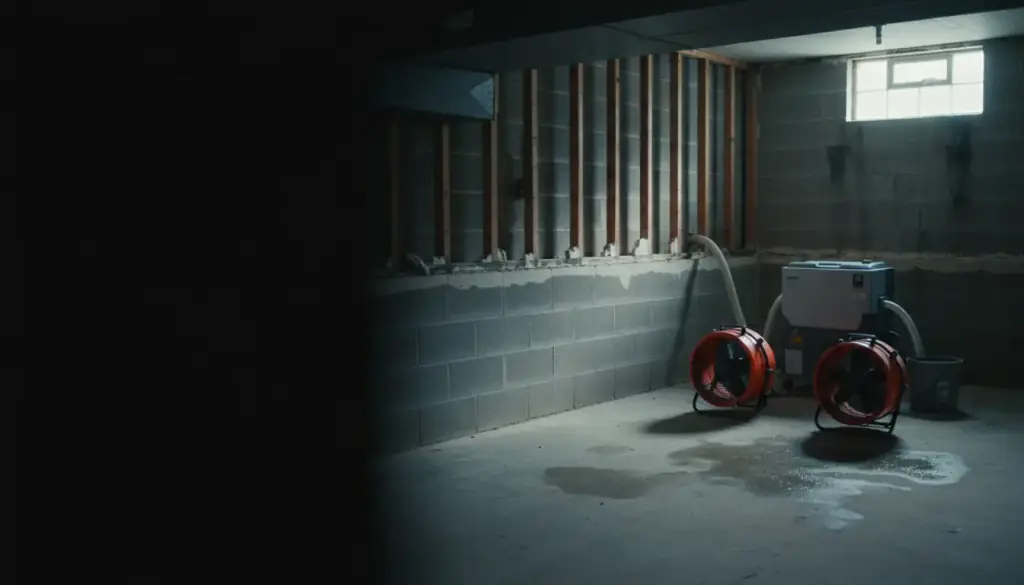
Dark basement mid-drying: two orange air movers and a dehumidifier on damp concrete, with the lower wall opened to the studs
Pumping down, cutting out and drying a flooded basement
Triage on the 24/7 hotline starts with safety. Within minutes of your call our team responds and is ready to work, and before anyone steps into standing water we check what is still energized and whether the water is clean enough to walk through. We'd rather tell you to stay upstairs than put anyone at risk.
Mitigate begins with extraction. Submersible pumps handle depth and truck-mounted and portable extractors take the rest. When groundwater outside is still high, we pump the basement down in stages, so we aren't dropping the water level faster than the ground around the foundation can follow. Then comes the cut-out: the wall opened to the studs well above the waterline, contaminated insulation and flooring bagged and removed, and every surface that can be saved scrubbed and treated with antimicrobial.
Restore is a dry-down on damp concrete and open framing. LGR dehumidifiers work the air while air movers push across the slab and along the studs, and our IICRC Certified Restoration Technicians return to read the meters and reposition equipment until the framing and the slab hold a dry reading. Back Safe & Sound means the basement is ready for new drywall, not just for a quiet night.
Contents, the slab and how a flood claim is documented
Concrete is the slowest thing in the basement to dry, and the one most often called finished too early. A slab can feel dry underfoot and still be giving moisture up to the first layer of new flooring. We take readings on the slab as well as the walls, and we keep them, because a moisture reading is what tells you whether it is safe to rebuild.
Soft goods that survived, like clothing, linens and stored fabric, are a separate decision from the building materials. Some can be cleaned and returned, and Strategic Source has a household goods and textiles service for that. Mold is the risk if either the structure or the contents go back into a damp room, and the remediation page is linked below if growth has already started.
Insurers treat flood, groundwater and sewer backup differently from a sudden pipe break, and we can't read your policy for you. What we can do is work directly with your insurance and keep the record: photos, moisture logs and a written scope. We've also partnered with a seasoned public adjuster who assesses the damage right after you call. Estimates are always free, here in Fort Lee and across New Jersey.
“Over the winter we had a pipe burst in our basement leaving at least three feet of water in the basement.” Kevin L., Vernon, NJ.
Not sure whether what you have is a flood, a leak or a backup? That’s a fair question to ask us before you move anything. Call the hotline, or tell us what the basement looks like on our contact page, and we’ll sort out which one it is.